Applied Data Science With Generative & Agentic AI
( A Placement Oriented Program )
Master AI. Unlock the Power of Generative Intelligence
100 % Placement Opportunities with
| Hands-On Projects Industry | Recognised Certification
Eligibility: BE, B.Tech, ME, M.Tech in ECE, EEE, E&I
(Graduate/Under Graduate /Working Professional)
From spreadsheets to transformers — the complete data and AI stack
Most programs teach either analytics or AI. This one does both — from SQL queries and Power BI dashboards to machine learning, deep learning, NLP and Generative AI — so you can work across the full data-to-AI pipeline.
Data foundations
SQL, Python, Advanced Excel, Power BI and exploratory data analysis from the basics.
Machine Intelligence
Supervised and unsupervised ML, evaluation, feature engineering, CNNs and sequence models.
Generative edge
NLP, text and embeddings, Transformers, GANs, RAG, Generative AI and agentic workflows.
Analytics and AI in one program
Practical analytics skills alongside core AI and ML engineering concepts.
Industry frameworks
Hands-on tools, Python libraries, systems and common industry workflows.
Generative AI built in
Transformers, embeddings, prompting, engineering and applications.
Three capstones
Projects that demonstrate practical, end-to-end skills.
Problem-solving focus
Complexity analysis and competitive coding in Python.
Classroom-led learning
Guided, structured learning across the full AI stack.
500 hours · 3 tracks · 12 modules · 3 capstones
Core Programming → Analytics Specialization → Advanced AI Specialization
Core Programming
SQL, Python and problem-solving
RDBMS using MySQL
Discover, query and manage relational databases with MySQL.
Key topics
- Introduction to databases and RDBMS concepts.
- Database and table creation.
- Creating schemas and inserting, updating and deleting data.
- Basic and advanced SQL queries.
- Filtering, sorting and aggregating data.
- Joins and relationships between tables.
- Subqueries and nested queries.
- Grouping, HAVING and aggregate functions.
- Constraints, primary keys and foreign keys.
- Normalization and relational database design.
- Views, indexes and query optimization.
Python Programming & Advanced Python
Write robust, reusable Python programs for analytics and applications.
Key topics
- Python basics, variables and control structures.
- Functions, modules and packages.
- Lists, tuples, sets and dictionaries.
- Strings and built-in methods.
- Loops, conditions and comprehensions.
- Exception handling and debugging.
- File handling and working with JSON.
- Object-oriented programming.
- Regular expressions and text processing.
- Working with libraries and external packages.
- Data structures and algorithmic problem-solving.
Capstone Project — Python
Problem definition · Design · Implementation · Testing · Review
Analytics Specialization
Excel, Power BI, Pandas and machine learning
Advanced Excel
Analyze data and build interactive dashboards with advanced Excel.
Key topics
- Excel interface, data entry and formatting.
- Formulas, functions and cell references.
- Logical and lookup functions.
- IF, SUMIFS, COUNTIFS and related functions.
- Data validation and conditional formatting.
- Sorting, filtering and cleaning data.
- PivotTables and PivotCharts.
- Charts, reporting and dashboard design.
Data Analysis & Reporting using Power BI
Build interactive business dashboards and reports.
Key topics
- Data sources and Power BI Desktop.
- Importing and transforming data.
- Power Query and data cleaning.
- Data modeling and relationships.
- DAX measures and calculated columns.
- Visualizations, filters and slicers.
- Interactive dashboards and drill-through.
- Publishing reports and sharing insights.
Exploratory Data Analysis with Pandas
Clean, summarize and visualize datasets using Python and Pandas.
Key topics
- NumPy, Pandas and data structures.
- Reading CSV, Excel and other datasets.
- Data cleaning and missing-value treatment.
- Filtering, sorting and transformations.
- Grouping, aggregation and pivoting.
- Combining datasets with merge and join.
- Statistical summaries and distributions.
- Matplotlib and Seaborn visualizations.
- Outlier detection and exploratory analysis.
Machine Learning Fundamentals & Advanced ML
Build and evaluate models for practical data science problems.
Key topics
- Supervised and unsupervised learning.
- Regression and classification.
- Feature engineering and feature selection.
- Training, validation and test datasets.
- Linear and logistic regression.
- Decision trees and random forests.
- K-nearest neighbors and support vector machines.
- Clustering and dimensionality reduction.
- Model evaluation and cross-validation.
- Hyperparameter tuning and pipelines.
- Scikit-learn model development.
Capstone Project — Data Analytics
Problem definition → Data preparation → Analysis → Insights → Presentation
Advanced AI Specialization
Deep learning, NLP and Generative AI
Deep Learning using TensorFlow
Develop neural-network models for data and computer-vision applications.
Key topics
- Deep learning concepts and neural networks.
- Artificial neurons, layers and activation functions.
- Loss functions and optimization.
- Forward propagation and backpropagation.
- TensorFlow and Keras fundamentals.
- Building and training neural networks.
- Convolutional neural networks (CNNs).
- Image classification and feature extraction.
- Overfitting, regularization and dropout.
- Model evaluation and deployment basics.
Natural Language Processing
Turn unstructured text into meaningful information and language models.
Key topics
- NLP fundamentals and text preprocessing.
- Tokenization, stemming and lemmatization.
- Stop-word removal and text normalization.
- Bag of Words and TF-IDF.
- Word embeddings and vector representations.
- Text classification and sentiment analysis.
- Named entity recognition.
- Sequence models and recurrent neural networks.
- Attention mechanisms and Transformers.
- Language-model applications.
Generative AI & Agentic AI
Build AI-powered tools, workflows and intelligent applications.
Key topics
- Introduction to Generative AI and LLMs.
- Transformer architecture and attention.
- Prompt engineering and structured outputs.
- Text generation and summarization.
- Fine-tuning and model adaptation concepts.
- Embeddings and vector databases.
- Retrieval-Augmented Generation (RAG).
- Building AI applications and workflows.
- Agentic systems, tools and function calling.
- Evaluation, safety and responsible AI.
Capstone Project — AI
Problem definition → Data and model design → Training → Evaluation → Deployment
Tools, platforms & hardware
Capabilities you’ll graduate with
Not just topics covered — data and AI capabilities you can demonstrate in an interview, a dashboard and a working model.
Command the SQL — query, join and aggregate relational databases.
Engineer in Python — build scripts, functions and reusable code.
Tell stories with data — build dashboards that make decisions clearer.
Explore data — clean, transform and analyze real datasets with Python.
Build ML models — regression, classification, clustering and evaluation.
Go deep — CNNs, RNNs, LSTMs and deep-learning workflows.
Understand language — NLP, embeddings, text processing and semantics.
Build with Generative AI — RAG, LLMs, Transformers and prompt engineering.
Ship AI projects — move from a problem to a practical AI solution.
Projects you’ll ship
| Project | Skills developed |
|---|---|
| Retail Sales Analysis | SQL, Excel, Python, business insights |
| Flight Price Prediction | Regression and model evaluation |
| Customer Churn Prediction | Classification algorithms |
| Customer Segmentation | Clustering and unsupervised learning |
| Fraud Detection & Image Processing | Data processing, ML and computer vision |
| Goods Recognition | Image classification and CNNs |
| Generative AI System | LLMs, embeddings and RAG |
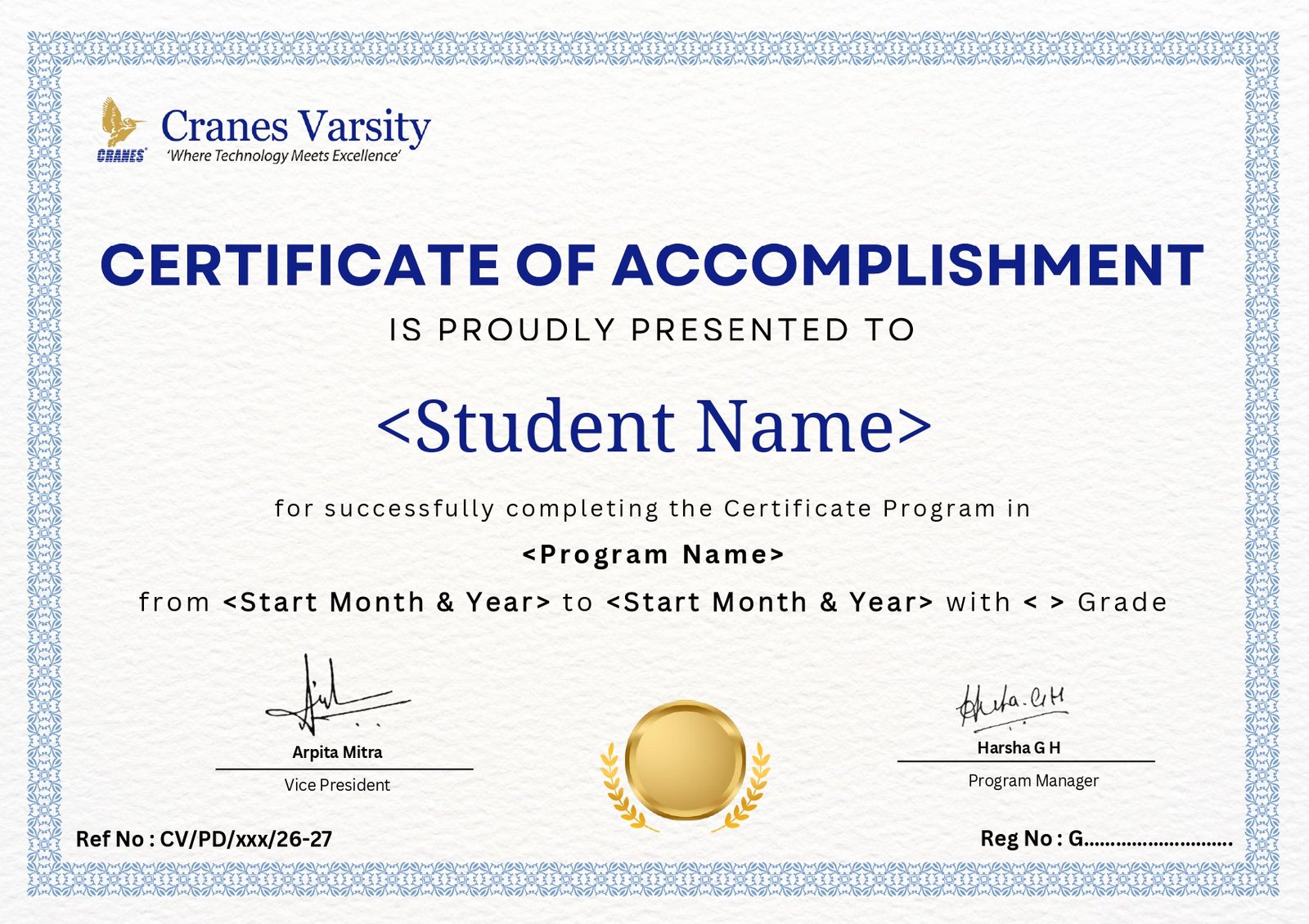
Three certifications, one progression
Python Programming Certification
Core programming fundamentals and problem-solving skills.
Data Analytics Certification
Master the skills of practical analytics and reporting.
PG Diploma in Applied Data Science with Generative AI
Advanced ML, deep learning, NLP and Generative AI applications.
Demonstrate your skills through hands-on projects, practical assignments and portfolio-ready outcomes.
Built for data, ML and Generative AI careers
Intensive training and placement assistance for high-growth data and AI roles, powered by career-focused learning.
Learn
Build practical foundations, technical skills and confidence through structured learning.
Practice
Code challenges, datasets, guided assignments and real-world industry problems.
Assess
Demonstrate competence through assessments, projects and technical reviews.
Get placement-ready
Interview preparation, resume guidance and practical portfolio development.
Industry job roles
Industries hiring
IT services and product companies, banking and financial services, e-commerce and retail, healthcare, manufacturing, consulting and technology.
Who should enroll?
Graduates, B.Tech, BCA, BSc, MCA and other learners who want to build careers in data science and AI.
Beginners who want to develop practical skills in analytics and machine learning.
Professionals looking to upskill in Python, machine learning and Generative AI.
Hiring Client










Frequently asked questions
What is the duration of the PG Diploma in Applied Data Science with Generative AI?
The program runs for a total of 500 hours at 4 hours per day, delivered offline and instructor-led.
How is this PG Diploma different from a diploma in AI and ML?
In addition to SQL, Python, Excel, Power BI, Pandas and machine learning, it adds an Advanced AI Specialization covering deep learning with TensorFlow, computer vision with OpenCV, natural language processing and Generative AI, plus a third AI capstone.
What Generative AI topics are covered?
Rule-based vs neural generation, GANs, variational autoencoders, transformers, subword models, sentence embeddings, prompt engineering with zero-shot and few-shot prompts, and the applications and ethics of Generative AI.
Which tools and frameworks will I use?
Anaconda, Jupyter, Google Colab, MySQL Workbench, Excel, Power BI, Pandas, NumPy, Matplotlib, Scikit-learn, TensorFlow, PyTorch, Keras, OpenCV, NLTK, Gensim and Word2Vec.
How many certifications and capstones are included?
The program includes 3 certifications and 3 capstone projects: Python, data analysis and AI.
What jobs can I apply for after the program?
Roles include Data Analyst, Power BI Analyst, Python Developer, ML Engineer, Data Scientist, AI Engineer, Deep Learning Engineer, NLP Engineer and Generative AI Engineer.