Advanced Diploma in Embedded System
( A Placement Oriented Program )
Learn from Industry Experts | Work on Real Hardware | Build Career-Ready Projects.
100 % Placement Opportunities with
| Hands-On Projects Industry | Recognised Certification
Eligibility: BE, B.Tech, ME, M.Tech in ECE, EEE, E&I
(Graduate/Under Graduate /Working Professional)
Why choose this embedded systems program?
Build a strong career foundation in embedded systems — from analog circuits and digital logic to MISRA-C, data structures, ARM Cortex-M firmware, peripheral drivers, communication protocols, FreeRTOS, modern C++ and Linux.
Embedded C, MISRA-C, ARM Cortex-M, driver stacks, protocols, FreeRTOS, C++ and Linux.
Real development on LPC1768 and STM32 boards with industry-relevant exercises.
FreeRTOS tasks, scheduling, queues, semaphores and interrupt management.
GCC, Keil / µVision, Flash Magic, VS Code and Linux.
Progressing with practical, application-level real-world projects.
Blended online learning with classroom Digital Academy sessions.
Training, projects and assessments designed for embedded roles.
Embedded systems curriculum: 4 phases, 11 modules, 2 capstones
Hardware Foundations → Core Programming → Embedded Software → Firmware & Drivers
Electronics & Hardware Familiarization
The hardware behind embedded systemsCore Electronics: Analog Circuits to Digital Logic Design
Understand essential digital and analog circuit fundamentals and the hardware behind embedded systems.
Key topics
- Basic laws, DC circuits and passive components
- Diodes, transistors, signal basics and logic gates
- Digital and mixed-signal switching, amplification and CMOS
- Microcontrollers and communication basics
- Power supplies, regulators and signal conditioning
- Logic gates, multiplexers, decoders and counters
- Flip-flops, counters and shift registers
- Finite state machines and basic sequential system design
- Sensors, actuators, reading schematics and datasheets
Core Programming & Problem Solving
C, MISRA-C and data structuresMastering C Programming following MISRA-C Guidelines
Write robust, MISRA-aligned C and build logical and data-driven programs.
Key topics
- C program structure, functions and control flow
- Pointers, arrays and strings
- Operators, expressions and associativity
- Functions and memory concepts
- Structures, unions and enumerations
- Bitwise operations and masks
- Character and string functions
- Searching and sorting algorithms
- Practical coding using MISRA-C
DSA for Problem Solving in C
Analyze algorithms efficiently and build problem-solving skills for embedded software.
Key topics
- Time and space complexity
- Sorting algorithms: Bubble, Selection, Insertion, Merge and Quick Sort
- Stacks, queues and linked lists
- Recursion, trees and graph basics
- Iteration versus recursion
- Patterns and problem-solving practice
- Data structures and memory concepts
- Searching and complexity analysis
Capstone Project – Programming
Problem definition → Solution design → Implementation → Testing → Technical documentation.
Embedded Software Programming
Embedded C, C++, Linux and build toolsEmbedded C Essentials
Use embedded C fundamentals to develop robust, resource-aware microcontroller applications.
Key topics
- Cross-compilation environments and build systems
- Variables, constants, scope and storage classes
- Control flow and bit manipulation
- Memory mapping and volatile
- Structure padding, alignment and memory layout
- Bit fields, pointers and function pointers
- Debugging and building embedded applications
- Source code and linker scripts
- Compiler and linker options
- Secure and safe coding standards
Modern C++ for Embedded Systems
Design modular, reusable software using C++ concepts and modern development practices.
Key topics
- Classes, objects and data structures
- Classes, objects, encapsulation, data hiding and abstraction
- Access specifiers and the this pointer
- Constructors, destructors and object lifecycle
- Inheritance and operator overloading
- Namespaces and reusable principles
- Exception handling, templates and smart pointers
- STL, algorithms, containers and iterators
Linux System Programming using C
Build Linux applications for system calls, processes, IPC and file handling.
Key topics
- Linux shell and commands
- Files, permissions, directories and file systems
- Basic scripting and control statements
- File descriptors and system calls
- Process management and signals
- IPC: pipes, message queues and shared memory
- Multithreading and synchronization with mutexes
ARM Cortex-M Architecture & Embedded C
Program ARM Cortex-M microcontrollers at register level with low-level interfacing.
Key topics
- ARM Cortex-M3 architecture and LPC1768 overview
- Embedded C and LCD programming
- GPIO and controller programming
- Interrupt handling
- NVIC and vector table concepts
- ADC with LPC microcontroller sensor
- Timer peripherals programming
Embedded Firmware & Driver Development
Protocols, drivers and real-time firmwareEmbedded Protocols & Peripheral Driver Development
Develop peripheral drivers, understand hardware interaction and implement communication protocols.
Key topics
- PWM, peripheral programming
- GPIO and Watchdog Timer
- SPI and clock configuration
- I2C and interrupt handling
- UART communication
- USART and communication protocols
- CAN communication
Embedded RTOS (FreeRTOS) Firmware Programming
Build reliable firmware with FreeRTOS tasks, scheduling, kernel communication and synchronization.
Key topics
- FreeRTOS features and source code organization
- Hard and soft real-time scheduling and execution
- Scheduling and context switching
- Heap and stack, FreeRTOS task management
- Semaphores, queues and mutexes
- FreeRTOS APIs, ISR, priorities and state transitions
- Scheduler, tick timers, stack and task use
- Queue blocking, notifications and synchronization
- Interrupt management, events, DMA and tasks
- Binary and counting semaphores
- Resource management and mutual exclusion
Capstone Project – Hardware
Apply architecture, hardware interfacing, peripherals, protocols and RTOS concepts in a complete project.
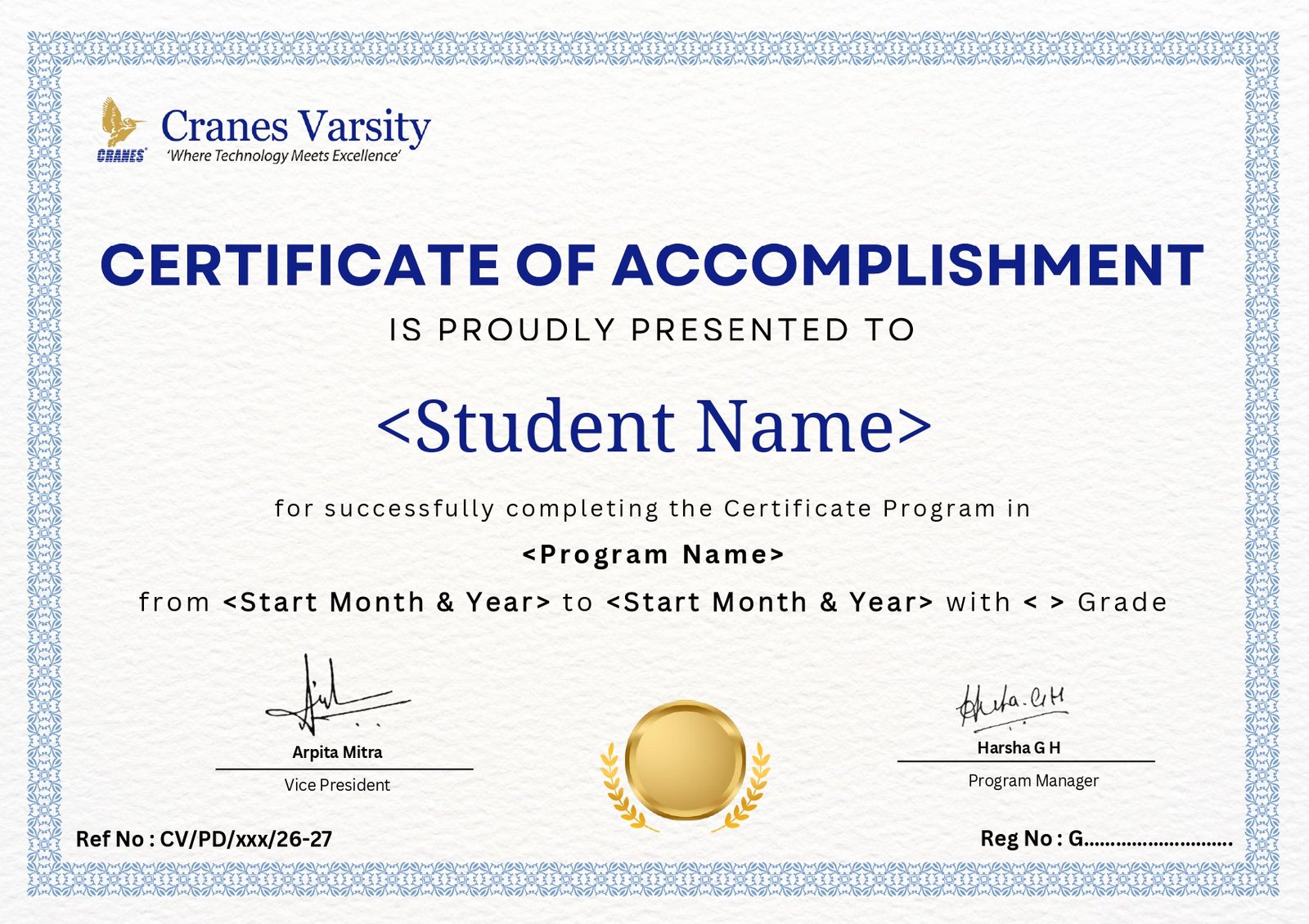
Final Diploma in Embedded Programming
Tools, software & hardware
What you’ll be able to do
Understand hardware — analog circuits, digital logic, schematics and datasheets.
Write clean C — structured, MISRA-aligned code for embedded applications.
Implement data structures — apply algorithms and data design for memory-constrained systems.
Master embedded C — memory, pointers, bit operations, final projects and debugging.
Design in modern C++ — modular, reusable software with OOP and the STL.
Program Linux systems — IPC and system calls, processes and multithreading.
Write drivers — UART, SPI, I2C, CAN, PWM and GPIO.
Build RTOS firmware — FreeRTOS tasks, queues, semaphores and scheduling.
Hands-on & capstone projects
| Project | Skills developed |
|---|---|
| Data Structures Applications | C programming, algorithms, memory management |
| Socket Programming Chat Server | Linux, networking, client-server communication |
| GPIO, UART, SPI & I2C Integration | Peripheral interfacing and driver development |
| Real-Time Data Acquisition | ADC, timers, sensor interfacing |
| Wireless Communication Projects | Device communication, data exchange |
| Sensor Data Logging System | Sensor integration, sampling, storage |
Project specifications may be customized to align with project and learner requirements.
Embedded systems jobs: from classroom to career
Interview readiness and placement assistance, powered by Career Digital Academy.
Learn
Structured materials, technical resources and self-paced modules.
Practice
Debug challenges, hardware labs and real-world projects.
Assess
Domain assessments, skill-gap analysis and personalized learning.
Get placement-ready
Resume preparation, interview practice, recruiter connections and job opportunities.
Industry job roles
Industries hiring
Automotive electronics, industrial automation, consumer electronics, semiconductor systems, IoT devices, medical electronics and embedded product development.
Hiring Client



























Frequently asked questions
The total duration depends on the delivery schedule, self-study requirements and assessment timeline. Refer to the official program schedule for the confirmed duration.
The program may combine digital learning, practical lab work and project-based activities. Confirm the available delivery mode with the program provider.
Engineering students and graduates from relevant branches, along with learners interested in embedded systems, firmware and hardware programming, may be suitable candidates.
The outlined learning path includes a programming certification followed by a Diploma in Embedded Programming after the required modules, assessments and capstone.
The program outline includes interview preparation, technical assessments and placement-readiness support. Confirm specific placement commitments with the provider.
The listed platforms include ARM Cortex-M LPC1768 boards, Raspberry Pi devices, sensors, displays and peripheral modules. Exact hardware availability may vary.