
PG Diploma · VLSI Design & ASIC Verification
From ECE Degree to Semiconductor Career
Lakhs of ECE engineering graduates. Very few become core VLSI engineers.
The difference is RTL, SystemVerilog, UVM and STA — and we teach exactly that, in 500+60 hours, with placement assistance.
0
%
hands on program
0
+
Hiring companies partnered
0
hrs
Core-to-signoff curriculum
100% Placement Assistance
Batch Start: 20th Aug 2026
Request Curriculum & Fee Details
A counsellor will call you within 24 hours.
- 500+ hiring partners recruit from this program
Years of Legacy
0
+
Engineers Trained
0
+
Engineers Placed
0
+
Hiring Partners
0
+
Google Rating
0
★


The part nobody puts on a brochure
What Semiconductor Companies Actually Look For — And Gap in Colleges Curriculum
Semiconductor companies don’t hire marks. They hire skills, problem-solvers, and industry-ready engineers.
"I know Verilog exists. I've never written a testbench that actually verifies anything."
College covers gates and flip-flops. Interviews ask about functional coverage, assertions and constrained-random verification — a language your labs never spoke.
The curriculum gap
"Every institute promises placement. Nobody explains what happens if I don't clear the mock interview."
A brochure line isn't a plan. You need to know exactly who preps you, how many attempts you get, and what "100% job assured" is actually backed by.
The trust gap
"My batchmates who went the 'do-it-yourself on YouTube' route are still job hunting eight months later."
Scattered tutorials teach syntax. Recruiters hire for RTL-to-signoff thinking — design, verify, synthesize, sign off — built through real capstone projects, not playlists.
The direction gap
Which is exactly why Cranes Varsity exists
A Decade-Plus of Feedback from India's Chip Industry, Condensed Into One Course
India’s semiconductor industry doesn’t need more electronics graduates. It needs engineers trained on what it actually hires for — RTL, SystemVerilog, UVM, STA, tested on the same Cadence and Synopsys-grade tools used on the job. Cranes Varsity has spent 14+ years working backward from 500+ hiring partners’ interview rounds to build exactly that. Not a syllabus. A pipeline.
The signal path
From analog fundamentals to a certified verification engineer — five clean stages, no detours.
Duration 500 + 60 hrs
Eligibility BE / B.Tech / ME / M.Tech
Level Intermediate
STAGE 01 · CORE ENGINEERING
Digital & Analog Foundations
Circuits, logic design, FSMs and timing basics — the physics under every gate you'll ever design.
STAGE 02 · PROGRAMMING
C, C++ & OOP Fluency
Structures, pointers, STL and OOP — the reasoning skills that later carry straight into System Verilog classes.
STAGE 03 · VLSI DESIGN
RTL, Protocols & FPGA
Verilog from gate-level to FSMs, UART/I2C/SPI/AXI4 design, and hands-on Artix-7 / Zynq SoC boards.
STAGE 04 · SPECIALIZATION
SystemVerilog, UVM & STA
Constrained-random verification, UVM testbenches, protocol verification, Python/TCL scripting, timing signoff.
STAGE 05 · MILESTONE
PG Diploma Certified
Portfolio of capstone projects + interview prep, backed by our placement desk and 500+ hiring partners.
Program Overview
Core Engineering
- Digital Hardware Familiarization
Core Programming
- Mastering C Programming – Self-Study
- Mastering OOP using C++
VLSI Design
- RTL Coding with Verilog
- On-Chip Protocol Design
- FPGA Programming
Specializations
Design & Verification
- Design & Verification using System Verilog
- ASIC Verification using UVM
- On-Chip Protocol Verification
Scripting & Automation
- Python Scripting
- TCL Scripting
Digital Physical Design & Timing Analysis
- Static Timing Analysis
- Digital Physical Design
What actually gets you shortlisted
Six Skills Recruiters Actually Screen For. All Included.
- SystemVerilog — Design & Verification
- UVM — ASIC Verification
- Protocol Verification
- Python for EDA Automation
- TCL & Linux
- STA
SV
Design & Verification using SystemVerilog
OOP, randomization, functional coverage, assertions.
UVM
ASIC Verification using UVM
Base classes, phases, TLM ports, reusable testbenches.
I/O
On-Chip Protocols Verification
UART, SPI, I2C and AXI4 — designed, then verified.
PY
Python Scripting for EDA
Automating reports, timing parsing, testbench utilities.
TCL
TCL & Linux Scripting
Shell automation and environment fluency EDA tools expect.
STA
Static Timing Analysis
Setup/hold, PVT corners, synthesis, signoff-level reading.
Where this actually lands you
Don’t Just Complete a Course. Prepare for These 6 Career Roles.
0
+
Hiring companies across the placement network
0
+60
Structured training hours, core to signoff
0
Capstone projects on real FPGA/EDA tooling
0
%
Job assistance backed by our placement desk
placements
Trusted by hiring partners across core & IT domains











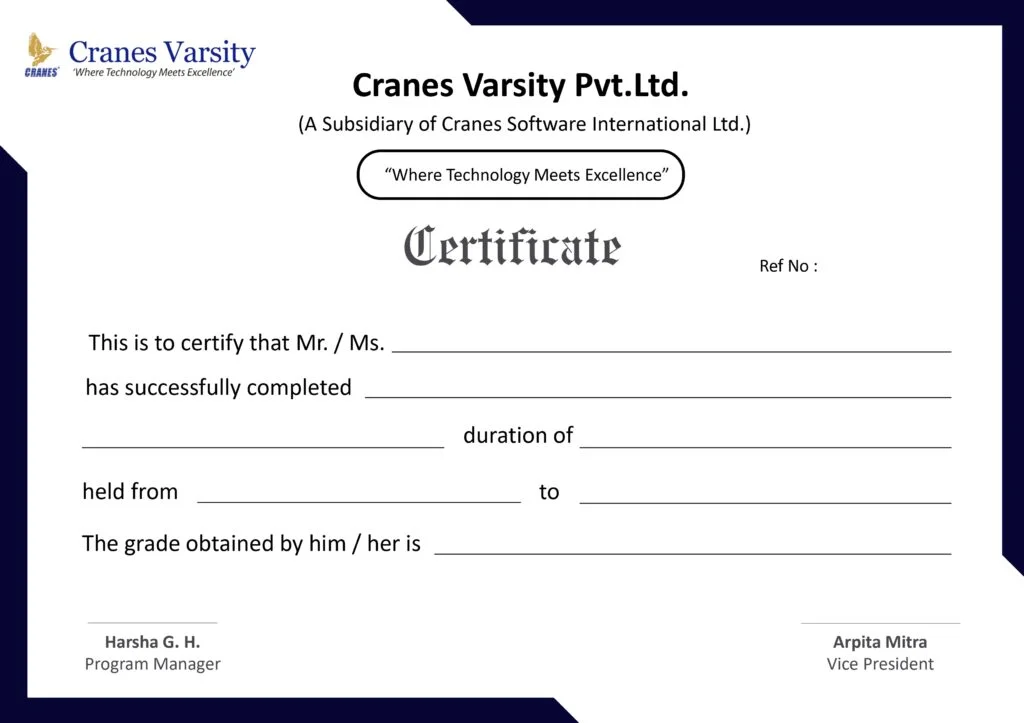
Proof you can put on LinkedIn — and defend in a panel
Trained the Way VLSI Companies Actually Hire For — Not Just Certified
I didn’t expect the interviewer to actually know Cranes Varsity’s name — but he did. I walked in with my UART and AXI4 capstone builds, and instead of generic questions, he asked me to walk him through my testbench. That’s when I realized the diploma wasn’t just a certificate — it was proof I’d already done the work they were hiring for.
"The difference wasn't the syllabus. It was that every mock interview felt harder than the real one."
— Recent graduate, PG Diploma in VLSI Design & ASIC Verification
Before you commit six months
The questions every serious applicant actually asks.
No. A basic grounding in digital electronics is enough — the program builds programming and RTL skills from the ground up across Stages 1–3 before specialization begins.
Resume preparation, structured mock interviews, and direct access to our network of 500+ hiring companies through a dedicated placement desk — running alongside the technical curriculum, not after it.
Yes — live, instructor-led online sessions are available for working professionals and remote students, alongside in-person cohorts at our Bengaluru campus.
Xilinx Vivado Suite, EDA Playground, OpenTimer, and physical Artix-7 FPGA and Zynq SoC boards — the same class of tools used in industry EDA flows.
Know What a VLSI Recruiter Looks For — Before You Apply, Not After You're Rejected.
Talk to an admission counsellor about eligibility, batch dates, and the scholarship test — no obligation, fifteen minutes.


